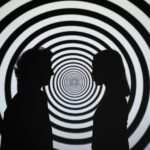
a term used to describe things that relate to the principle that says perceptions have 2 parts. The first is the figure and the second is the background.
What is figure-ground perception in psychology?
When we see an image, our minds race towards understanding what is presented in front of us and one of the ways we do this is through figure-ground perception; the organization of visual information or visual selection in the brain. This refers to the way in which our brains automatically separate the visual field (or image) into two components: the foreground (the "figure") and the background (the "ground").
The figure is typically the object or objects that we perceive as being in the forefront of our visual field, while the ground is the background against which the figure is perceived. The figure is usually perceived as being more prominent or important than the ground, which serves as a kind of visual backdrop.
Some of the ways we distinguish between figure and ground include:
- Blurriness: Where the figure is clear while the background is blurry.
- Size: Here the figure is larger and therefore easier to see while everything else is smaller and seems distant.
- Contrast: A high contrast between the figure and the ground makes it easy for us to differentiate the two and focus on either.
- Separation: We are able to separate or isolate the figure from everything else and easily see the figure rather than the background.
This concept is often used in the field of Gestalt psychology, which studies how humans perceive and interpret visual information. According to Gestalt psychologists, our brains organize visual stimuli into coherent patterns, and the figure-ground relationship is one of the fundamental ways in which we do this.
The way that our brains perceive the figure-ground relationship can have a significant impact on our interpretation of the visual scene. For example, if we see a person walking against a plain background, we are likely to perceive the person as the figure and the background as the ground. However, if the person is walking against a busy background, such as a crowded street, our perception of the figure-ground relationship may be more ambiguous, and we may have to work harder to distinguish between the figure and the ground.
Importance
Most of the things we see are cluttered, and without figure-ground perception it is impossible to filter out the relevant and useful information. Figure-ground perception allows us to locate the precise useful information despite the clutter and 'noise' that surrounds it. More specifically, this perception is important in
- Object recognition: By separating objects from their background, our brains can more easily recognize and identify objects in our environment.
- Visual attention: Figure-ground perception helps direct our attention to the most important parts of a visual scene.
- Depth perception: By analyzing the relationship between objects and their backgrounds, our brains can create a sense of depth, importance and perspective.
- Visual aesthetics: Figure-ground relationships can play an important role in visual aesthetics.
Examples of Figure-ground perception in real life
Not a day goes by that we don't use the figure-ground perception in real life. One good example is your ability to read this article. You are able to focus on specific words/letters and ignore the rest so that you get meaning. Other everyday examples include:
- Solving puzzles. The ability to look for the correct piece in a pile of many pieces.
- Finding specific words in a dictionary or a long list of words.
- Finding matching socks in a pile of socks.
- Sorting or pairing similar shapes or colors from a pile.
Another classic example is The Rubin Vase which was drawn by Edgar Rubin, a Danish psychologist. The image is of a black vase between two face profiles. The color contrast in this image calls for the role of perspective as one is able to see two 'different' images based on what they focus on.